Showing posts with label pasta. Show all posts

Monday, March 21, 2011

CARBONARA


Rachel - a food blogger based in Rome - wrote in this funny post about the carbonara-phobia that only recently she managed to overcome. The trauma (Post Bad Carbonara Stress Disorder, in her words) had been caused by weird versions of the recipe that she tasted over the years in various restaurants outside of Italy. She mentions overcooked spaghetti, cream, bad bechamel sauce, mushrooms, scrambled eggs and on one especially unfortunate occasion, sausage.

Traditional carbonara is a very simple dish. It's made with 3 (three) things:

cheese
eggs
pork fat, like guanciale or pancetta

and nothing else - well, salt and pepper. And you need spaghetti, too. But no cream, no onions, no mushrooms.

This simplicity is also what makes the sauce deceptively difficult to prepare, because of course carbonara needs to be creamy, and the key to get it creamy using only these ingredients is to bring the temperature of the beaten eggs somewhere around 65º. Not enough heat will produce a very liquid sauce and cold spaghetti (bleah), while too much heat will produce scrambled eggs - this by the way is by far the most common mistake of a carbonara beginner, that often pours the eggs directly in the pan with the sizzling fat.

Now, let's ask a couple of legitimate questions. Is this worth the hassle? Why use only these three ingredients and noticeably raise the difficulty level when we can just throw in some cream and basically be 100% sure that the final result won't resemble a badly shaped omelette?

Answers: yes, it's worth the hassle, the semi-cooked-eggy personality of a traditional carbonara is unique in terms of texture and taste. If you add cream you get something that looks similar but that is actually different, just like Chicago pizza is different from traditional pizza napoletana. Don't get me wrong, it's perfectly fine to add cream, lots of people do it; it just won't be carbonara, it will be something else. Plus keep into account that the above mentioned semi-cooked-eggy personality is rather addictive, it's likely that once you get used to it you won't be able to add cream to your sauce anymore. And finally the preparation of traditional carbonara has an elegance of its own: getting your timing right, the simplicity of the moves... this kind of things.

Rachel's post is comprehensive, informative and clear, I would almost be tempted to link it and lazily skip the actual recipe part. But then again, like she herself points out, there are many carbonara variants and I think mine (the Italian-living-in-Madrid-with-no-easy-access-to-guanciale version) is worth putting on paper. Another very interesting one is Dario Bressanini's yolk-only type; see below for some more detailed comparisons.


A word on pasta

I use only long varieties: spaghetti, spaghettini, linguine, bucatini, et cetera. Some people use short pasta too (Rachel goes for rigatoni), but personally I like it less, I think the whole dish doesn't come together as it should. I admit this is highly subjective, though:).

Here in Madrid it's easy to find Italian brands such as Barilla, Agnesi or De Cecco, all good options. Thanks to Chiara I also found out not long ago that some Hipercor pasta (Hipercor is the house brand of El Corte Inglés supermarkets, in case you don't know) is actually produced by pastificio Garofalo, one of the best pasta makers around. So now I always buy that, it's excellent and cheap. Just check the look of the product name: if it's sort of fake handwriting, like this

it's made by Garofalo. There should also be a small Garofalo logo somewhere on the package.


A word on pork

Traditionally carbonara is made with guanciale, which is pig's cheek cured and peppered (I love the stuff:)). A common alternative would be pancetta (bacon); the most obvious difference between the two is that guanciale has more fat, i.e. the white part of the meat is largely predominant over the pink part.

You can use a number of Spanish products as replacements: panceta fresca, panceta curada or tocino if it has at least some pink part in it and it's not 100% fat. I would not use smoked products, they usually don't release enough juices when frying. Whatever you use, it should look something like this piece of guanciale:


A word on cheese

Tradition dictates pecorino romano, but parmesan is often used as a replacement; sometimes you have a mix of the two. Here in Madrid I would go for a 100% parmesan, as it's not hard to find, or maybe a very strong queso de oveja curado (seasoned sheepmilk cheese).


Ingredients for 2:

200g pasta
2 eggs
80g tocino/panceta/guanciale...
40 g grated parmesan
pinch of salt
pepper
a glug of extra virgin olive oil

Heat a large pan of salted water until it boils. In the meantime put the parmesan, two eggs and pinch of salt in a small bowl, then whisk them together with a fork. Cut the pork fat in small strips or cubes, then put it in a large anti-stick pan, with a bit of extra virgin olive oil.

When the water boils, throw the pasta in and at the same time start cooking the fat in the anti-stick pan, on medium heat - Rachel says it perfectly, it should be fried until translucent and crisp at the edges. If it reaches this state when the pasta is far from ready, just lower to a minimum the heat under the fat.

Around two minutes before the pasta reaches the cooking time written on the package, turn off completely the heat under the pork fat. After another minute, grab some tongs and quickly transfer the pasta (which should be almost ready) in the pan of the pork fat. In the process you will also transfer quite some salted water; this is ok, it will make the sauce creamy and tasty.

If the pork fat reacts to the pasta with a lot of sizzling, it means the pan is very hot, so wait another 30 seconds; if there is some sizzling but not too much, this is the moment: pour the mix of eggs and cheese on the pasta, then toss/stir until the sauce is evenly distributed (and hopefully, not too liquid nor too solid).

Transfer the pasta to the individual plates, top with a generous amount of pepper and grated parmesan cheese, then serve.


Variants

Rachel and Dario describe different ways of dealing with the crucial add-the-eggs moment: Rachel tosses the pasta in the pan with the pork fat, then removes it from heat and add the egg mix still in the pan; Dario has a less risky approach, as he tosses the pasta, move it to a bowl and only then adds the yolks. This way he is sure that the eggy substance won't get in contact with any very hot surface - then again, he is only adding yolks; if he added whole eggs the temperature of the whole thing might drop too much, resulting in a very liquid sauce. Since I use whole eggs, I usually prefer Rachel's approach.

A sauce made only with yolks is definitely more powerful and filling, and is usually "cut" with some of the boiling water used to cook pasta - that's what Dario does. Rachel uses whole eggs, but add a couple of extra yolks at the end, and insists a lot on the importance of adding not less than a full cup of water (for 4 people). I am sort of in the middle: I use whole eggs, I don't add extra yolks, as I find the sauce tasty and thick enough, especially if I am using deeply flavored fat; and some water gets added to the sauce when I transfer the pasta using tongs.

The bottom line is, you should try and experiment, see what you like. Just remember that the key moment (the part that can go wrong) in all carbonara recipes is always the "baking" of the eggs.

Wednesday, January 12, 2011

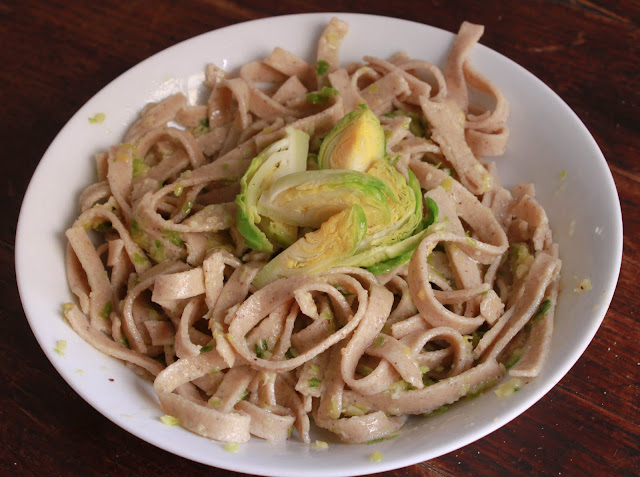
CHESTNUT TAGLIATELLE WITH BRUSSELS SPROUTS PESTO


Ok, I have to admit it: I’m in love with the entire cabbage family! I actually ignored them until a couple of years ago when I started receiving a bio-box* weekly. In winter the box is often full of savoy, broccoli, cabbage... and brussels sprouts! That’s how our love story started :).

Now, I know cabbage, broccoli & co. are not the most fun veggies on the planet, but let’s just try to forget their usual smell and all the related childish nightmares and let’s, instead, try to cook them in a “modern” way. I promise they won’t disappoint you. AT ALL :).

I was looking for a nice “sauce” for chestnut tagliatelle when I had my very own Epiphany seeing all the sprouts at my favourite fruteria del barrio :).

Tagliatelle:

150g chestnut flour
100g wheat flour
2 eggs

Place both flours in a bowl or on a board (I actually use my Kitchen Aid). Make a well in the centre and crack the eggs into it. Use a fork to beat the eggs until smooth, then mix them with the flour and start kneading. The result should be a smooth and elastic dough that you will cover with clingfilm and let rest for about 30 minutes before rolling and shaping it into tagliatelle.

Sauce:

250g brussels sprouts - external leaves
1/2 clove of garlic
100g hazelnuts
50g parmesan cheese, grated
2 tablespoons extra virgin olive oil
20g butter

Blanch 2 handful brussel sprout’s leaves for about 1 minute; strain them and then use a food processor - or a mortar, if you have some more time - to mash them with the half clove of garlic, the hazelnuts and the olive oil. Season to taste then add Parmesan cheese. Your pesto should have an oozy consistency; if it’s not the case just add a bit more olive oil or parmesan cheese.

Once the pesto is ready, slice the remaining brussels sprouts; melt the butter in a saucepan on a medium heat and add the sprouts. Cook them for a couple of minutes and then add 2 or 3 tablespoons of water. I like them better when they’re crunchy, but this is personal taste so just add some more water if you like them a bit softer.

In the meantime cook the tagliatelle in a pan of boiling salted water for 3 or 4 minutes; drain and then stir them into the pesto. Season to taste and serve adding some brussels sprouts slices.


*In case you're wondering what it is, a bio-box is a box containing bio veggies/fruits. You don't choose them, you just take what the season, the weather and the farmer give you :).
In Madrid it's pretty easy to find such thing: lots of bio-shops prepare boxes and there's a lot of online shops-farms, too, such as Cajanature, Milhistorias, Cestaverde…
Just google "cajas de fruta biologica madrid" and you'll find an entire bio world :)!


Thursday, December 23, 2010

RAGÙ, AKA BOLOGNESE SAUCE

It is fairly well known that Italians love to talk about food (just look at Chiara and me, we have a food blog!). But to tell you the truth, Italians talking about food often turn out to be a conservative, stubborn bunch, "campanilisti" to the bitter end. Campanile means steeple; every little town in Italy has a church with a steeple, so campanilista is someone with limited views and ideas, that mindlessly supports the traditions and the views of the environment he comes from, no matter how small/suffocating. The way we cook [insert name of dish here] in [insert name of town here] is the best; it doesn't matter if somewhere else the same dish is prepared differently, what do they know in [insert name of rival neighbor town here]?

Maybe the fact that culinary traditions in Italy are very diverse is sort of a positive side effect of this widespread mentality. In any case, I just wanted to warn you about this campanilismo thing first, as a kind of disclaimer. This is my recipe for ragù, it is a fairly traditional one and I believe it gives splendid results; but there are a million other recipes out there, so don't think of it as the Secret Official Traditional Ragù Bolognese. It is entirely possible that other Italians will tell you their version is better - maybe it's true, ask them to prove it. Me, I am not even from Bologna. Also I put milk, and I am pretty sure many people don't do that ("Milk??" they would probably think if they'd read this, "Crazy!!").

(actually, there was this episode of a TV show called In Search of Perfection where this famous chef is sort of searching for
the perfect ragù, and it's funny how the cook from Bologna replies to his question about the use of milk in the sauce: "Definitely not in this city!")

So, without further ado, my recipe.


Timing:
-a couple of hours (unless you use a pressure cooker, that's half the time)

Some useful tools:
-a deep antistick pan with a lid (or a pressure cooker if you feel fancy, or a Thermomix if you feel super-fancy)
-a blender (optional, if you feel lazy)


Ingredients:
-80g butter
-800g beef minced meat
-200g bacon or sausage; basically any pork meat with a good amount of fat works, I think. I usually go to the market and ask for panceta, not smoked (ahumada) nor salted (salada), just plain panceta
-1 onion

-1 carrot
-1 celery

-1 glass of red wine
-1 regular can of tomato sauce, or 1 regular can of whole tomatoes; in this case just break them into pieces before throwing them in. Careful not to buy tomate frito by mistake
-1 teaspoon of concentrated tomato

-1 meat stock-cube

-around 1/4 of a liter of milk (or maybe some more)
-nutmeg
-pepper
-salt

Note that with these amounts you will get a lot of ragù, enough to feed some ten people with spaghetti. Remember it lasts a few days in the fridge - I find that it actually tastes better one or two days after you have made it. You can also freeze it, of course.


How to:
Chop onion, celery, carrot and fattie pork meat into little pieces (if you are using panceta, remember to remove the hard skin/parts from it). You can also throw everything in a blender if you have one, it's actually faster (I kind of wonder if some defender of the tradition would disagree on this. Maybe they'd claim the heat generated by the the blender would alter the taste of the ingredients, like in the case of pesto alla genovese?).

Throw the chopped stuff plus the butter in the deep antistick pan, and turn on the heat to medium. Stir every now and then. After 5 mins, add the beef and keep stirring. When the beef is browned, throw in the glass of wine, keep stirring for a few more minutes. When the wine is absorbed/evaporated, throw in the tomato sauce and the spoonful of concentrated tomato; stir again, then throw in enough milk to completely cover the mass of meat and veggies.

At this point I generally add one stock-cube, a teaspoon of salt, some pepper, and half a nutmeg (grated, of course. By the way, it's a good idea to buy whole nutmegs and grate them when needed rather than using pre-ground ones, the difference in taste and fragrance is substantial - you probably know already, but just in case).

Lower the heat, cover with a lid but without closing the pan completely - leave the lid a bit askew. The sauce should simmer for at least one and a half hours, and become a thick creamy thing. Every now and then stir, check that it's not getting too dry (you can add milk again, or just water), and taste, of course, in case you have to add seasonings.


Variants:
I recommend you try some ragù experiments of your own, this is a very flexible preparation: if you take a look at Heston Blumenthal, the British chef I linked above, you'll see he does some really crazy stuff.

I once replaced the regular red wine with Pedro Ximenez dessert wine; that made the sauce much sweeter, I used it for lasagne and they were very well received. Other times I tried to put smoked salt in the sauce, and I liked the result a lot (but might be because I love pretty much all smoked food). I also tried to use whisky, cognac, rosemary, etc, it's all stuff that gives some interesting twist.

Beef: which cut?
There are discrepancies here, as some sources claim lean cuts are better, while others prefer parts that include fat. I favor fat cuts, first of all because they are cheaper, and personally I think of ragù as proletarian food, a bit like chili con carne. Lean cuts just don't belong here :). Besides, fat cuts cooked slowly in liquid are supertasty. So my choice would always be the regular minced meat that you can find at the market (and that usually has quite some fat), supported by good old panceta.